
Back to the future
This series explores the great upheavals that India is currently undergoing. And it follows the people who are navigating these changes. Part three takes us back to Bangalore, where an unusual alliance of well diggers and entrepreneurs are trying to save the city.


• If these were scenes from a film about post-capitalism, they would seem over-staged: IT experts taking boats to work on flooded streets. Managers in shirts and pleated trousers wading through the water to their offices. The pride of the city, the successful tech nerds, standing on trailers like cattle, being pulled to work by tractors. In September 2022, 24 hours of heavy rain brought Bangalore to a standstill, uprooting trees, cutting off electricity and parts of the drinking water supply. The east of the city, where the nearest incubator is always a stone's throw away, was particularly affected: The floods caused around €25 million worth of damage to IT companies and banks in a single day.
What happened in Bangalore in the autumn of 2022 tells us a lot about people's work ethic. And even more about the dilemma of a booming IT city reaching its natural limits. Bangalore generates about 37 percent of the gross domestic product (GDP) of the state of Karnataka. It is also one of the richest states in India, with an average per capita income 77 percent higher than the rest of the country. But what is the future of a metropolis with a looming water crisis?
Bangalore is not the only city asking this question; around the world, the deadly climate-induced merry-go-round of floods and water shortages is accelerating. In Europe, extreme events such as the floods in the Ahr valley in Germany, the heatwave that brought French nuclear power stations to their knees, and the ongoing drought in Spain, where water rationing has begun even before spring, are making headlines. The world's metropolises are particularly affected, especially in the South: by 2050, 6.2 billion people will be living in cities, almost twice as many as today. And they will all need water - but where will it come from?
Bangalore will be hit particularly hard, as the city has no natural access to water. More than half of its drinking water has to be pumped from the Cauvery River, about 100 kilometers away, through five huge pipelines to the city, which sits on a plateau. These pipelines are the lifeblood of the IT metropolis; roughly eight per cent of India's GDP depends on them (see box).
This dependence is particularly bitter because Bangalore was once known as the „Garden City“ and „City of a Thousand Lakes“, a pioneer in urban irrigation. From the 16th century onwards, the rulers of Bangalore created artificial lakes in which rainwater could be collected, used by the population and fed back into the groundwater table. Today, 400 years later, urban planning around the world has rediscovered this principle under the name „sponge city“.
But of the thousands of lakes in Bangalore, only a few remain: 60 to be exact. Where there used to be water, there is now concrete. Decentralised water supply from lakes and wells gave way to modern pipelines in the 19th century. Today, 55 per cent of the city's drinking water comes from the Cauvery River, the use of which has been the subject of dispute between the states of Tamil Nadu and Karnataka for more than 200 years. The remaining 45 percent comes from legal and illegal boreholes, which are contributing to a drastic decline in the city's groundwater table (see box).
Back in 2010, a senior member of the state government claimed that half of Bangalore's population would have to be evacuated by 2023 due to water shortages. In 2018, the BBC reported that the city would soon run out of drinking water. And the influential government think-tank Niti Aayog predicted in the same year that Bangalore would run out of groundwater by 2020.
But it didn't come to that. Not least because of the people who are not waiting for politicians and administrators to act, but are taking matters into their own hands. Well builders, engineers and entrepreneurs who are combining tradition and modern technology to save the former city of a thousand lakes from drying up.
A mission in four steps.

Every child in the Mannu Vaddar knows: if you take water, you have to give water

1. The forgotten water system
One of the pioneers is Vishwanath S (he abbreviates his surname Srikantaiah, as is customary in southern India). The 61-year-old engineer welcomes visitors to the living room of his small house in the north-east of the city with an open copy of The Hindu on the table, as if he has just finished reading it. One of the last liberal dailies in the country, he says, indicating the paper.
He has worked for decades repairing Bangalore's ailing water cycle, leaving his secure municipal job years ago to found the NGO Biome Trust. To underline the urgency of his cause, Vishwanath S points to the newspaper in front of him. In it are reports of a brief thunderstorm in the east of Bangalore that the day before had caused hours of chaos on the Outer Ring Road, one of the lifelines of the city.
„People need to understand what is happening beneath their feet. Only then can they take responsibility for it,“ says Vishwanath S. Bangalore's water surpluses and shortages are linked to the city's boom: The population of the metropolitan region has grown from 8.6 million to 13.6 million since 2011, and the area of paved land has increased a thousandfold in the last 40 years. There is nowhere for the rain to run off.
Moreover, the existing water is not sufficiently treated. The water authority treats about 60 per cent of the wastewater; the rest should be treated in decentralised plants (as is required for large residential, industrial and commercial buildings) - but this is hardly monitored. Anyone walking along the city's open sewers can see and smell the problem. The barely filtered sewage from thousands of kitchens, showers and toilets is fermenting there.
In other words, the city has enough water, but it is badly managed. Now, one could blame the inactive administration and curse the consumption-hungry city dwellers who wash their SUVs every day. But Vishwanath S is thinking ahead: „We need a new water culture. One in which the citizens participate and in which we combine the knowledge of the past with new technology.“
This insight came to him in the form of a well builder. „20 years ago, out of the blue, a man asked me in the middle of the street if I wanted a well,“ said Vishwanath S. Hawkers are common on the roads of India. But those offering wells aren't.
The well digger spoke of communities called Mannu Vaddars or Bhovi, who have passed on their well-digging knowledge for generations. Long before a central authority pumped water into the city, they built and operated open wells. These provided access to water from the shallow aquifer, a kind of sponge of earth and rock in which seeping water is stored and released into deeper layers. With the introduction of tap water, however, the knowledge of the well diggers became less important. Most retreated into farming.
„It was through this chance encounter that I realised that we had a second, functioning water system that had simply been forgotten,“ says Vishwanath S., „a system with a huge potential!“ So he had a well dug in his front yard, a 1.20 metre wide and four metre deep shaft lined with concrete rings. Not to draw water - he covers his needs with filtered rainwater - but to recharge the water table.
Unlike in pre-industrial times, the new wells have to be carefully designed to prevent pollutants from leaching into the groundwater. „Insufficiently filtered water is a risk, and chemical contamination is virtually irreversible,“ says Shashank Palur, a hydrologist at Well Labs, a water, environment and soil research institute in Bangalore. This can be avoided by not building absorption wells too close to roads and industrial areas, and by ensuring that rainwater is filtered through dozens of metres of sand and rock. But in densely built, fast-growing cities like Bangalore, he says, soakaways are an important factor in preventing groundwater from dropping. Today, there is simply no room for the thousands of lakes that used to seep into the ground. That's why Vishwanath S. didn't stop at his own well in his front yard: he networked with well builders to start revitalising wells across Bangalore as soon as possible.

Fighting for the revival of old wells: engineer Vishwanath S
2. The well diggers
Cubbon Park in the centre of Bangalore is a good example of what this can achieve: In this 80-hectare park, families stroll through the greenery, lovers frolic in the shade of the rain trees, a reading club meets by the lotus pond. Away from the paved paths that criss-cross the vast park, we meet Ramakrishna K R (who also abbreviates his surname) and Shankar (who has no surname). They have been restoring the park's forgotten wells, securing its water supply.
The two men are sitting on a wall next to a large red fountain. Until a few years ago it was as dilapidated as the other six fountains in the park, overgrown and forgotten. Now the two craftsmen smile shyly as they inspect the work they have done. „It makes us happy and proud to see the fountains. Even if we didn't build them, they are the work of our community, our ancestors,“ says Shankar. Ramakrishna K R looks critically at the murky water at the bottom of the well: „It needs to be cleaned urgently.“
A well doesn't work like a tap. It needs maintenance, regular cleaning of leaves and silt, and an understanding of local water bodies and their dependence on rain. In short, you need experts like Ramakrishna K R and Shankar, who have done nothing else since they were 15.
The wells they dig with shovels are fed by the shallow aquifer. When a shaft is dug into the spongy rock filled with rainwater, it fills up automatically. Unlike boreholes, from which water is pumped up to 500 metres deep in some parts of Bangalore, the traditional wells are only a few metres deep - as long as rain can seep in, they are a simple and reliable source of water.
For a long time, the Mannu Vaddars thought their skills were no longer needed: „We knew our wells provided safe water,“ says Ramakrishna K R, „but who would believe us, ordinary people?“ No one in their community has ever attended secondary school, let alone studied. But they know how the smell of the earth changes just before you hit water. And that you can't pump forever from the depths without causing seepage on the surface. But only since Vishwanath S., with his university degree and contacts in administration and politics, joined the Mannu Vaddars have they been listened to again.
In 2015, Vishwanath S and other activists from the environmental foundation Biome launched the One Million Wells campaign: One million borewells and absorption wells would be built within ten years to raise the city's water table. The projects are often sponsored by companies as part of their corporate social responsibility - an important source of funding. The environmental foundation itself is supported by the Rainmatter Foundation (see „Where the wild unicorns graze“) - so money from the start-up scene is flowing into the city's well-building programme.
And so, in 2017, the water cycle at Cubbon Park was revitalised. As the wells had been forgotten and dried up, irrigation water was being trucked in. The Mannu Vaddars then restored the six historic wells and dug a further 74 absorption wells. The project cost around €330,000 and was funded by Biome Trust and two charitable trusts. Today, the wells are once again producing water - around 65,000 litres a day - to meet almost all the park's needs. The additional infiltration wells also protect against flooding and add hundreds of thousands of litres to the groundwater each year.
Word of this success has spread: According to a Unesco report, the Mannu Vaddars have built or revitalised more than 200,000 manholes and wells in Bangalore over the past eight years. Vishwanath S. puts the figure much higher: „Wells are being built everywhere. When a company or an individual has something built, we usually don't even know about it. But this is part of our vision: knowledge about the wells should take on a life of its own.“
The fact that the project is helping to raise groundwater levels is evident from the many reports of wells that have been producing water for years: in Cubbon Park, at the Indian Institute for Management, and in residential areas. It is also a good sign that the average groundwater level in Bangalore will rise by more than 2.5 metres between 2020 and 2022. But according to hydrologist Shashank Palur, it also rained a lot during those years: „There has been no scientific monitoring of the wells so far, so the success is based on experience and anecdotal evidence.“
In any case, business is good again for the well builders. Ramakrishna K R speaks proudly of his son and daughter, who are now at university. This is the first generation in which the child of a well digger no longer has to become a well digger. „We are very happy that our work and that of our forefathers is being recognised,“ says Shankar, „the city is giving us work again and we are giving the city water.“
The well initiative has now been replicated in ten other Indian cities at the initiative of the Union Ministry of Urban Affairs.

Goes down better than recyclate: well water
3. High-tech drinking water
But closing the loop requires more than wells. It requires a new way of looking at sanitation. In Bangalore, says Vishwanath S, few people see this as clearly as entrepreneur Vikas Brahmavar.
To understand his business, you have to visit the Orion Mall, one of the city's largest shopping centres. Fountains at the entrance, brightly lit flagship stores on four floors, eight hectares to satisfy the consumer appetite of India's middle class. But what makes this mall special is what happens in the basement - almost in secret.
In Bangalore, large building complexes must either treat and reuse their wastewater or find companies to take it away. In fact, the research institute Well-Labs estimates that around 70 percent of wastewater is discharged illegally. Orion Mall is a positive exception. In the building's little-used underground garage, hidden behind floor-to-ceiling tin walls, is a plant that converts wastewater into drinking water.
„Water is a precious resource. And our system ensures that we can reuse it instead of throwing it away after a single use,“ says Brahmavar. Standing in front of the filtration systems that his company, Boson White Water, has installed here, he explains: „Water from the mall's mandatory sewage treatment plant is pumped into our system and purified in eleven stages. Fully automated and remotely controlled.“
Transparent pipes show the various stages of treatment, with each filtration, membrane and UV treatment transforming the murky water into clear drinking water. „Bacteria, heavy metals, pesticides and herbicides are removed, and we have the water tested regularly by certified laboratories,“ says Brahmavar, tapping a glass that was toilet water a few hours ago for confirmation and drinking it down in one gulp.
Apart from him, however, no one here drinks this water - it is only used in the Orion Mall to cool the building. That also requires clean water. 90,000 litres a day can be treated, saving the mall 2.7 million litres and 217,000 euros a year, according to Boson White Water.
The 33,000 euro system remains the property of Boson White Water and the mall pays 2,280 euros per month for the treated water. It is a contribution to environmental protection, but the mall's operators do not want to boast about it. „We brought this banner to the opening three years ago to advertise the savings and our project,“ says Brahmavar, pointing to a poster hidden behind a water tank, „but they don't want customers to know about the recycling.“
The founder knows the problem: trust in the technology is low and the stigma is high (see box). In India, where water also has a significant spiritual value, its purity is particularly important. So introducing recycling requires sensitivity. Brahmavar says that all his projects require long preliminary discussions and a lot of persuasion. „There are high psychological barriers to using treated water,“ he says. „But since there's no way around it, we'd better start as soon as possible.“
As a child Vikas Brahmavar saw how conflicts over water can escalate. „When I was ten, my father told me: If someone bangs on the front door, run out the back door and hide with the neighbours.“ Back in 1991, 16 people died in a conflict over the distribution of water from the Cauvery River. „It's probably a strong memory that drives me,“ he says.
Before becoming a water entrepreneur, Brahmavar worked as a programmer for an investment bank in London. But he wanted to return to India to make a difference in his home country, he says. „Many entrepreneurs who have been abroad have unrealistic expectations of the Indian administration. We can't rely on a centralised system like in Europe, our cities are growing too fast for that.“
Experts say that Bangalore's subsidised water price of less than one cent would have to be increased tenfold just to cover operating and maintenance costs. For this reason, Brahmavar does not expect much from the municipal waterworks. „We have to rely on decentralised systems. Greater acceptance of recycled water is the key.“
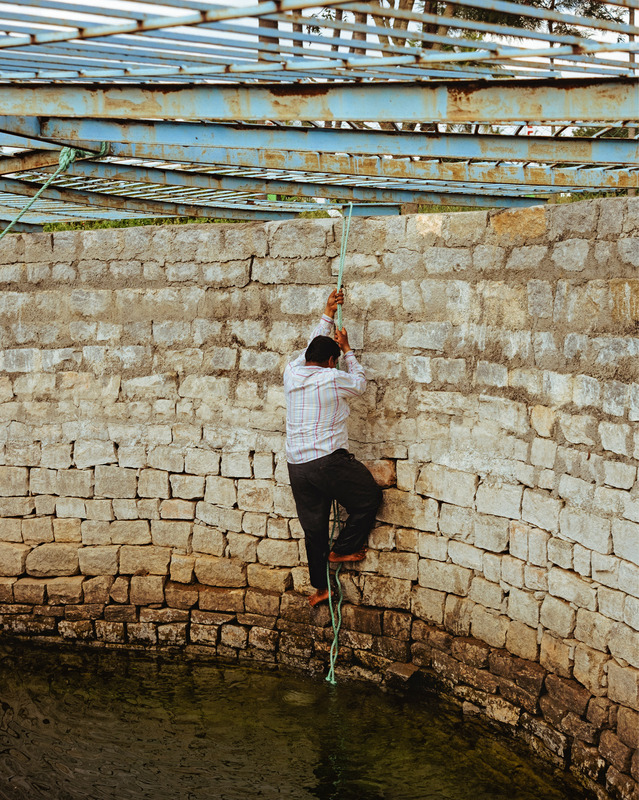
More work than a tap: Shankar maintaining a well in Devanahalli
4. Symbiosis on the outskirts
The suburb of Devanahalli in the north of Bangalore is where the art of well-building and ingenuity come together. The untrained eye sees a lake surrounded by millet fields and coconut palms, a well and a brightly painted maintenance shed. Water expert Vishwanath S. sees the future here. He says: „This is the first installation in the whole of India for indirectly recycled drinking water“ - a solution to remove the stigma of traditional water management.
And this is how it works: The lake is filled with treated water from a public sewage treatment plant. The lake feeds the shallow aquifer, which in turn feeds a centuries-old well that Mannu Vaddars has restored and which is now flowing again. In this way, treatment plant water becomes well water. A natural rebranding that ensures greater acceptance. The well water is then treated in a Boson White Water plant to produce drinking water, which is then supplied to people in the surrounding area. In this way, water from the treatment plant becomes lake water, then well water, then drinking water. A long way to go. But one that helps to overcome people's reservations.
The 10,000 people in the surrounding villages used to rely on water from boreholes up to 300 metres deep. Now they receive up to 250,000 litres of clean drinking water a day from the new plant, which is tested monthly by the Indian Institute of Science.
Research institutes such as the Well Lab in Bangalore are following the project closely. „There is a strong 'yuck' factor when it comes to direct reuse of wastewater. In a survey, the majority of people were unwilling to use treated water for anything other than toilet flushing and gardening,“ says urban planner Shreya Nath. „But if this water is first discharged into a lake or well before it reaches households, acceptance will increase.“ This could be crucial for the future of water use. People wouldn't even need to drink the recycled water, as most of the daily water demand is used for washing, rinsing and bathing.
The Devanahalli project cost about 27,000 euros, funded by the Rotary Club and the local branch of Carl Zeiss India. Because the water is already filtered by the natural percolation between the lake and the well, running the treatment plant costs no more than 40 euros a month, says Vishwanath S., „about the same as the fisherman who pulls the carp out of the lake and sells them in the market.“
The system has been in operation since November 2023, and the yellow flower garlands and ritual turmeric markings from the inauguration ceremony are still fresh. „Until now, people in the area have mainly used the water for household purposes rather than for drinking,“ says Vishwanath S. Confidence in the fusion of tradition and technology has yet to grow. „We don't just want to provide more clean water. We want people to understand where water comes from and where it goes,“ he says. As well as old knowledge and new technology, this also requires patience. ---
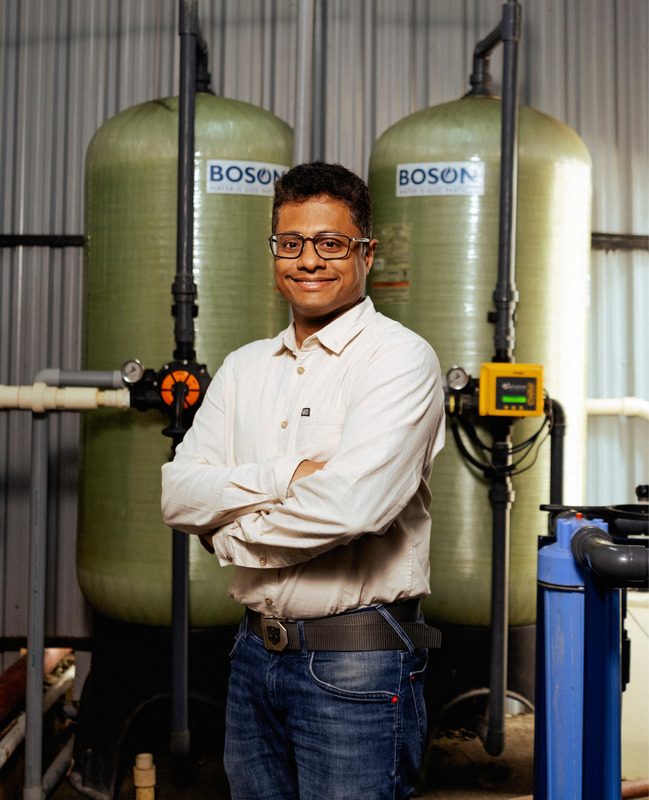
Vikas Brahmavar from Boson White Water
Water in figures
Demand for water in cities is growing worldwide. The UN expects an 80 percent increase by 2050, by which time more than half of the world's population could face water shortages as urbanisation continues.
1.5 billion litres of river water are pumped into Bangalore every day. But this only meets half of the city's needs. It costs an estimated €300,000 per day to operate the pumps. The plan is to expand the infrastructure by April 2024 and provide tap water to the entire population. Experts question whether the measures will be enough.
According to media reports, there are around 12,000 public, 370,000 licensed private and an estimated equal number of illegal private groundwater wells in Bangalore. Experts estimate that more than 600 million litres of groundwater are extracted every day, but only 240 million litres flow back. A single infiltration shaft can allow up to 4,500 litres of water to seep into the ground every rainy day. Unesco estimates that the digging and maintenance of the wells in Bangalore has generated an income of around 889 million euros for the well diggers since the start of the One Million Wells campaign.
In total, Indian cities produce 72 billion litres of wastewater every day. If treated and reused, this could ensure long-term water security despite the climate crisis, according to the think tank Council on Energy, Environment and Water. Bangalore already has the most decentralised urban wastewater treatment plants in the world, with around 2,700. But all too often, the treated water ends up in the drains. Elsewhere, it is used more intensively, such as in Israel, where 90 percent of wastewater is treated and used in agriculture. Or in Singapore, where high-tech treatment plants meet 40 percent of the country's water needs (mainly for industry and cooling).
What is „pure“ water?
Devout Hindus consider water to be contaminated if it has come into contact with 'impure' people of lower castes - social reformer and future father of the Constitution B R Ambedkar protested against this as early as 1927 by asking thousands of so-called 'untouchables' to drink from a water tank intended for higher castes. Yet a hundred years later, people are still being killed for drinking from the same jug as supposedly higher castes. In May 2023, two boys were killed for doing so in a suburb of the IT metropolis of Bangalore.

Clear separation: drinking water above, toilet below
––––––––

This series is funded by the European Journalism Center, as part of the Solutions Journalism Accelerator. This fund is supported by the Bill & Melinda Gates Foundation.
None of these organizations have any influence on the content.