
India
A country on the move
One in five people on the planet now lives in India. The world's largest democracy is becoming increasingly important internationally. Also for Europe. An insight into a country whose economy is growing by a good six per cent a year and which has to provide free basic food to more than half the population.
A series about a land of contrasts
This series explores the great upheavals that India is currently going through and follows the people who are navigating these changes. Like our first protagonist, ironer Motilal Kanojia.

Motilal Kanojia on his way to work
• Motilal Kanojia is where he always is. In his self-built shed in Mumbai, a metropolis of 21 million people on the west coast of India. And he's doing what he always does: heaving his cast-iron iron, with red coals glowing inside, over the business shirts and saris of his neighbours. From dawn to dusk, seven days a week. He has been here for more than 25 years, he was here when we visited him in 2019, and he will be here until he can no longer lift the iron (see also Mikroökonomie 07/2020). This will be his life, and the 44-year-old is under no illusions: „I'm an old man. The only thing that matters to me now is my daughter's life.“

Motilal Kanojia's (right) opening hours are Monday to Sunday - as a day laborer, he can't afford public holidays from his ironing stall
„I inherited my fate from my parents - but my daughter will go to university later!“

At the age of 16, his father sent him 1,500 kilometres away to Mumbai, then called Bombay, which promised a better life as an emerging financial centre. His parents, like their parents and grandparents, earned their living ironing. The big decisions in Motilal Kanojia's life had already been made when he was born. The son of an ironer becomes an ironer. Just as the sun rises in the morning and sets in the evening. His parents determined the rest of his life a little later when they chose his wife and sent him to Mumbai (see info box).
Kanojia and his charcoal iron symbolise the eternal India. A country whose borders and rulers have changed many times over the millennia, but which is held together internally by a force that seems capable of digesting any change. Just as Hinduism is not afraid to incorporate the gods of other religions into its own cosmos. This is the eternal India that we have visited time and again, and that we rediscovered in the research for this series. And yet this time everything is different - even for Motilal Kanojia.
For the country is in the midst of upheaval. Nearly one in five people on the planet live in India. In a reality that has both accelerated and slowed down. The world's most populous country is hungry for prosperity, progress and a voice. Few economies are growing faster. India's energy demand alone will double between 2020 and 2035.
Between 2010 and 2021, gross domestic product (GDP) grew by an average of 5.3 percent, making it Asia's third-largest economy at 3.4 trillion euros. Although the pandemic has slowed the pace, the government expects real GDP growth to reach 6.8 per cent in 2025.
Between 2011 and 2019, the proportion of people living in extreme poverty (less than $2.15 a day) was halved. The official unemployment rate was 3.2 per cent in 2023. More than half a billion people are employed in India, and more than half of them are self-employed.
According to the State Bank of India, the number of people filing income tax returns is expected to increase sixfold - to 482 million - by the time the country celebrates its centenary of independence in 2047. This would put the country in the league of middle-income economies.
On paper, this all sounds great. But reality is more complicated. How distorted the picture painted by precise figures can sometimes be will be discussed later. For now, it is enough to note that the world's largest democracy is in the midst of a hyper-transformation that brings with it both opportunities and dangers. And that it is moving ever closer to Europe. Because of the growing distance to China, the battle for skilled labour and the free trade agreement. So far, the applied principle has been when a bag of rice falls over in China, the supply chain in Germany shudders. Anyone looking further ahead should keep an eye on India's rice paddies.
No easy task in this elusive country, where freedom fighter Mahatma Gandhi and his assassin Nathuram Godse are both worshipped as patriots; and whose richest man, Mukesh Ambani, looks out from the bedroom of his private high-rise with 600 employees at his neighbours, hundreds of whom share a toilet.

Modi everywhere
On the one hand, there is Narendra Modi, whose likeness has lately been smiling from every open space in the financial capital, sometimes filling facades, sometimes stretching for miles on billboards. On the other hand five years ago a taxi ride felt like a trip through an teenager’s Netflix home screen, the city was full of gaudy Bollywood posters of muscle men saving bikini-clad women from explosions, by the end of 2023, shortly after the G20 summit in Mumbai, there seems to be only one film left: Great Power India. Written, directed and starring Narendra Modi. The entire city is wallpapered in the colours of the ruling party. A muted green, a warm orange and a benevolently superior smiling prime minister with a full white beard. A bit like a care home for the melancholic.
As the world tries to rearrange its alliances, India stands in the middle with open arms and a proud chest. Here there is no doubt about who is one in the new China-plus-one world. The message of the ubiquitous posters is progress and unity.
But when it comes to unity, there is disunity. The country is deeply divided politically. Many of the country's 200 million Muslims and other minorities feel increasingly marginalised and threatened by the ruling Hindu nationalists (see box). Depending on who you talk to, the circumstances range from euphoria to despair. Some fear for their lives, some dream of emigrating, others see golden times ahead.
And what about progress? Where is it hiding in Motilal Kanojia's charcoal iron stall? Who still works like his great-grandfather? Who can read little Hindi and no English, and earns so little that the tax authorities leave him alone? Progress is in his back pocket. Those who pay him six rupees (seven cents) to iron a shirt no longer hand him a paper note, but scan a barcode on Kanojia's mobile phone. He has thrown away his well-worn notebook, in which he used to painstakingly record the amounts owed to customers who paid him with notes that were too large for him to hand out change. Now the money always arrives within seconds.
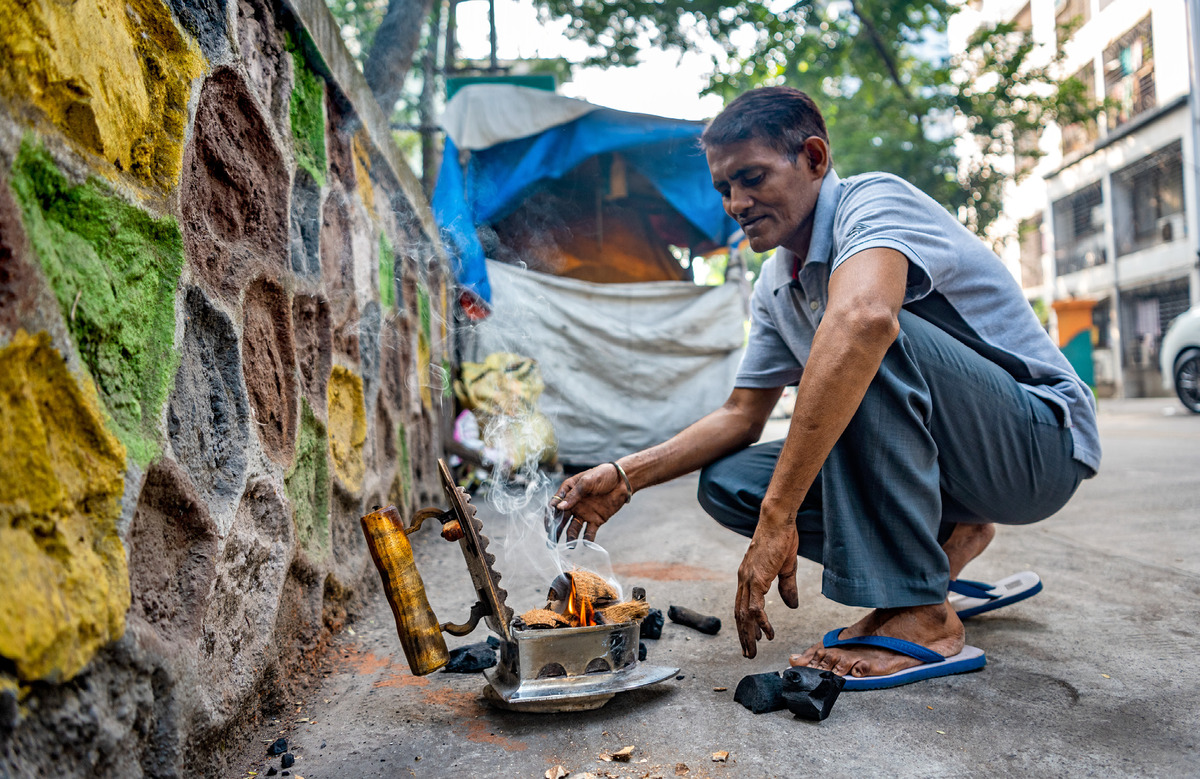
Heated with coconut fibers and charcoal (above), paid by app (below)

Say goodbye to cash
Every tea vendor at the railway station, every onion seller on the roadside now charges in this way. It's as if an entire country has simply switched from analogue to digital. Cash has lost its meaning. No matter who we meet as we travel around the country, almost everyone has replaced their wallet with their mobile phone. ATMs no longer attract crowds, only dust. Cash seems as practical here as a VHS tape or a landline phone. This is one of the great upheavals that this series deals with.
The political players argue about who is to blame for the sudden digitalisation - the government or the pandemic. But it undisputed the result of an enormous administrative effort. A feat that has given 1.4 billion people a quick and easy payment system that works astoundingly.
JAM is responsible for this. The acronym stands for Jan Dhan (account for all), Aadhaar (social security card) and mobile telephony. These three building blocks have enabled a digital ecosystem that is setting global standards. The aim of this government programme in 2014 was to connect the entire country to the banking system. Until then, around half of the adult population did not have a bank account. The World Bank and the International Monetary Fund estimate that this costs between half a percentage point and two percentage points of India's gross domestic product each year. The United Nations has identified financial inclusion as a key goal for the sustainable development of emerging economies.
One of the government's most urgent goals was to get a grip on the payment of social benefits. Imagine paying benefits to hundreds of millions of unaccounted beneficiaries spread across 600,000 villages, some of which are only accessible by foot. And this in a country that can be compared with German bureaucracy when it comes to complexity. As a result, most payments were channelled through corrupt middlemen. Even those who had to take out loans without a bank account had to rely on dubious businessmen. The government's cheap microloans are only available to people with an account. Unattainable for the main target group: India's 90 to 150 million farmers (this figure is also disputed).
The first part of the JAM programme was the nationwide provision of mobile phones and internet. The success story is well known. With it came increased prosperity and education - but also the number of lynchings as a result of hate speech on social media. Today, 1.2 billion people in the country have a phone with internet access; the cheapest rates costs less than a euro a week. That means almost the whole country is online, and 5G coverage is better in every fishing village than on the ICE train between Kassel and Hanover.
The second part is the Jan Dhan accounts: bank accounts that are easy to open and have no minimum deposit. The aim was to connect the previously marginalised half of the population with the modern world of money. And they got connected. In the first few years, an average of two million accounts were opened every week. By the end of August 2014, this figure had risen to 18 million per week - enough for an entry in the Guinness Book of Records.
Nine years later, 500 million people have opened an account and deposited a total of €22.8 billion. Some 55 million of them receive social benefits which are paid into the account. Two-thirds of the account holders are local, and more than half of them are women.
The third stage of JAM was the Aadhaar card. Anyone who wanted to receive money from the government from 2018 onwards had to be biometrically registered. In return, they received a card with a 12-digit identification number linked to their address and bank account. A requirement that even the country's poorest people could now meet. By November 2023, nearly 1.4 billion Aadhaar cards had been distributed, covering almost the entire population.
JAM is another building block in a larger structure called the India Stack. It addresses the country's key digitalisation issues: Making all citizens virtually prepared for business, paperless government and cashless payments. All with an open interface to the private sector.
This brings us full circle back to Kanojia's iron stall. Once people had internet access, accounts and unique identification numbers, the Unified Payments Interface (UPI) - the payment system Kanojia now uses every day - was born. The digital interface links all the accounts in the country and allows transfers to be made in a matter of seconds. Free of charge.
Perhaps the greatest miracle is that it works perfectly. In August 2023, more than ten billion monthly transactions were recorded, with a volume of 167 billion euros. A small portion of this has gone to Kanojia, who says that now he no longer has to carry cash in his pocket, it is also easier for him to save.

The financial metropolis of Mumbai attracts day laborers from all parts of the country
Great success - for almost everybody
The International Monetary Fund describes JAM and the India Stack as milestones for other countries as they move into the digital future. The modular structure is groundbreaking, and the fact that the pieces fit together so well, thanks to open standards. Businesses have been involved from the beginning and have contributed to the development - in their own interest. Today, 68 per cent of all national rupee transfers go through the UPI interface. The government now reaches those it wants to reach with social services and microcredit. And the private sector is also benefiting. While physical identity verification used to cost banks an average of eleven euros per customer, it now costs just five cents, thanks to the government's digital infrastructure.
Of course, changes of this magnitude aren´t without fault. The Aadhaar card, for example, as simple as the idea sounds, has its pitfalls. In a country with more than 100 language families and 200 million illiterate people, even spelling a name can be a challenge. And once you get stuck in the wheels of Indian bureaucracy, the only thing that helps is prayer.
And it is by no means just the poorest who are affected. Aakar Patel, the former director of Amnesty International India, showed how many ways his own name is misspelt on official documents. He had 'Akar Patel' on his birth certificate, 'Akkar Patel' on his electricity bill and 'Aakarpatel' on his voter ID card. Any visit to the authorities can become a problem. The Indian government also froze the NGO's accounts in 2020, effectively putting an end to its work.
With attacks on minorities on the rise, some people also feel uncomfortable about being included in a database with biometric data and their current address (see box).

Motilal Kanojia and his daughter Pooja on their way to work - her father wants her to study
What to do with all these young people?
Although he is happy about the new money on his mobile phone, Kanojia is one of the last to get connected. It took until September 2023. He is an old man, he tells us, and no longer understands the new technology. He is happy that a regular customer set him up. His hopes for the future lie with his daughter. All his earnings go into into her education: „I inherited my fate from my parents - but my daughter will go to university later!“ She may not be able to resist this plan any more than he was able to resist his father's. Even today, a child's life is still largely determined by his or her parents - across all class boundaries (see box). The significant difference is that Kanojia's plan for his daughter breaks with age-old traditions.
The child of an ironer does not become an ironer - a revolution perhaps greater than the digitalisation of a subcontinent. And the man with the serious expression on his face is not the exception, but the rule. This time we meet people from all walks of life who proudly show us photos of their children in front of the country's schools.
This revolution is growing up in the classrooms of India. They are the children of washers, ironers and well diggers. When they look ahead, they see a promising future of new opportunities and upward mobility. But when they look to the side, they see millions upon millions of their peers with the same aspirations. This clouds the view.
More than 600 million people in India are under the age of 25. Youth unemployment is a good 23 per cent - that's almost 60 million young people looking for work. And every month, a new million people enter the Indian labour market - if you lined them up, the queue would stretch from Munich to Hanover. Every month!
The problem is that the order books of the manufacturing industry are not full, and the state's cash reserves for huge infrastructure projects have already been exhausted just before the elections in spring 2024. According to the World Bank, not a single net new job was created between 2011 and 2018. It´s not surprising that 3.5 million people recently applied for 40,000 temporary jobs in the Indian army, and twelve million people fought for 35,000 jobs in the recruitment process at Indian Railways. This is meant literally: there was a riot.
But the number of unemployed only tells part of the story. Underemployment is perhaps more serious. In a German owner-managed café there usually is just one person working, in India there are often a dozen employees stepping on each other's toes. One person opens the door, another takes the order, another brings it, another makes the coffee, cashiers, cleans and so on. None of them are unemployed, but none of them are fully employed or fully paid.
The situation is even worse in agriculture, which employs 50 per cent of the country's workforce but contributes only 20 percent to GDP. The conflict over the fields is another fault line in Indian society. There are disputes over subsidies, archaic farming methods and farmer suicides, which are still commonplace. In September 2020, hundreds of thousands of farmers besieged the capital, Delhi, for months and were involved in skirmishes with the police. The issue was the need for reforms and whether they should serve farmers or big business
The agrarian crisis has exposed a deep divisions in Indian society. Between urban and rural populations that sometimes seem separated not just by miles but by centuries. While people in Delhi sip lactose-free cold brew lattes in air-conditioned jazz cafes, a teacher in the state of Rajasthan, two-and-a-half hours away by car, beats a student to death for drinking water reserved for higher castes.
The series
After this prelude, it will mainly be our Indian colleagues who will have their say, as they know their country best and can describe it from different perspectives.
Over the next few issues, we will look at the agricultural sector from the perspective of the person who brought farmer suicides to public attention 30 years ago. It's about women farmers who are finding solutions where others have long since given up. We travel to the forgotten hinterland on the trail of the government's giant solar projects, and take a look at Unicorn Street in Bangalore, where you can't finish your tea without two start-ups being launched next door. We get to know a city once famous for its irrigation skills that is now in danger of collapsing under a water crisis, and we visit the Indian model state of Kerala, whose digital education programme has been adopted by Finland.
We see breathtaking progress and deadly lethargy, and meet people who are bridging differences and shaping change. --
We see breathtaking progress and deadly lethargy, and meet people who are bridging differences and shaping change.
India in facts and figures
Indian philosopher Amartya Sen likes to quote his mentor, British economist Joan Robinson, as saying: „The frustrating thing about India is that whatever you can rightly say about it, the opposite is also true“. This is still true today.
Population
According to the United Nations, India has the largest population in the world, ahead of arch-rival China. This means that the country has quadrupled in size in three generations. The average age is about ten years lower than in Western industrialised nations; one in five people under the age of 25 worldwide is Indian.
Religion remains a strong influence. About 80 per cent of all people in India are Hindu. Muslims make up about one-seventh of the population, followed by Christians and Sikhs, whose monotheistic religion originated in the 15th century in the Indian state of Punjab and places great emphasis on community service. Buddhists and Jains also live in the country. The latter practise non-violence, chastity, non-ownership and detachment from worldly attachments.
Number of people of the Muslim faith, in millions, ...
… in Saudi Arabia: 34,2
… in Turkey: 83,2
… in Egypt: 104,7
… in India: 211,2
… in Pakistan: 225,6
Average number of children per woman in India, ...
… in 1950: 5,9
… in 1992: 3,4
… in 2021: 2,2
Average number of children per woman in Germany, in 2021: 1.58
Percentage of under-25s in India ...
… in 2022: 43,3
… in 2100: 23,9*
Percentage of over-65-year-olds in India ...
… in 2022: 6,9
… in 2100: 29,8*
(Sources: UN; PEW, Destatis, India Census; *estimate)
Economy
Figures on India's economic situation are deceiving. They exist, but their meaning is limited. India is the world's fifth largest economy, growing at a good six per cent a year, according to official statistics, and the unemployment rate will be just three per cent by 2023.
This would be cause for celebration if it weren't for the fact that 64 percent of possible taxpayers earn so little that they pay no tax at all. According to the tax assessment, the average monthly income is the equivalent of 180 euros a month - and there are huge numbers of underemployed and over-qualified people. Three out of four adult women neither have a job nor are looking for one, apart from unpaid housework.
On the positive side, there are massive infrastructure projects, with more than €1.5 trillion (twice as much as 2017-2023) earmarked in the 2024-2030 budget - some €400 billion for green investment alone. The comparison could go on and on. One thing is certain: there are successes, there are problems - and the country's potential is enormous.
Gross domestic product in 2022, in trillions of euros, ...
… in Japan: 3,9
… in Germany: 3,7
… in India: 3,1
… in the UK: 2,8
… in France: 2,5
Percentage of people in India living on less than 2.15 dollars a day ...
… in 1977: 63,1
… in 2004: 39,9
… in 2021: 11,9
Percentage labour force participation rate of women in 2022 ...
… in India: 24
… in Germany: 56
Average monthly income per person in India in 2023, in euros: 180
Inflation rate in India, in per cent, ...
… in 2020: 6,2
… in 2021: 5,5
… in 2022: 6,7
… in 2023: 5,5
Inflation rate in Germany, in per cent, …
… in 2020: 0,4
… in 2021: 3,2
… in 2022: 8,7
… in 2023: 6,3
(Sources: IWF, World Bank, State Bank of India, »The Economic Times«)
Yoga
Few things amuse people in India more than the Germans' obsession with yoga. Or rather: German yoga. Because what is sold in Germany as techno, beer or naked yoga is about as popular in India as Hawaiian pizza in Italy. Until it was rediscovered by the prime minister as a Hindu world heritage site, Indian yoga was as attractive to young people as „trimm-dich“ trails are to ours. While in Germany the cosmopolitan, health-conscious and urban milieu is almost united on the mat, in India hardly a cock crows about the physical contortions to which the West often reduces yoga.
Percentage of people in India who practise yoga ...
… daily: 7
… weekly: 13
… never in their lives: 62
Vegetarianism
As with yoga, vegetarianism in India is the opposite of that in Germany. In Germany, vegetarians tend to be the left-liberal clientele who give up meat out of concern for their bodies, the environment and animal welfare. In India, those who do not eat meat or alcohol are considered conservative. The vegetarian diet is closely associated with the Hindu idea of purity.
Traditionally, only the highest class, the Brahmins, abstain from meat altogether. And they are a minority in the country. Anyone who wants to stand up to them, or show solidarity with other groups, eats meat. German tofu barbecues are as subversive in India as beer taps at the Oktoberfest.
Funny as it may sound, Indians can't take a joke when it comes to food. Only half of them would accept an invitation from people who follow different eating rules. Brutal attacks on people who are, or are perceived to be, associated with beef - which is forbidden to Hindus - have been on the rise for years. A meat trader from Mumbai recently applied for asylum in Ireland. Without success.
Percentage of people in India who follow a vegetarian diet: 39
Percentage of Hindus in India who believe that anyone who ...
… does not believe in God: 49
… eats beef: 72
Love
Although love usually wins in Bollywood films, in real life it is the family that decides who gets married. And not just in traditional rural families. No, everywhere. Although many, especially in the educated urban milieu, have their love affairs in their youth, some even across religious boundaries, when it comes to marriage, most return to a partner from their own community, either chosen by their parents or at least with their consent. Until then, they usually live with their parents.
Percentage of people in Indian cities ...
… whose marriages were arranged: 93
… who married for love: 3
Percentage of arranged marriages among ...
… 80- to 89-year-olds: 94
… 20- to 29-year-olds: 90
Percentage of 15 to 35-year-olds who ...
… still live with their parents: 65
… live with their spouse: 31
… live with friends or alone: 4
Percentage of women in Indian cities in 2012 who knew their husband before marriage: 13
Percentage of women in major Indian cities in 2012 who were allowed to have a say in their parents' choice of partner: 70
Religion
Marriage outside one's own religious group is even more unusual than choosing a partner without parental consent. So unusual, in fact, that the state runs its own safe houses in secret locations to offer protection to interfaith couples threatened with death by their families (see Lovers' Saviours). In many cases this is not an empty threat. Even friendships usually take place within religious boundaries. Tolerance increases with education: the higher the level of education, the more mixed the circle of friends.
Percentage of people in India who have predominantly or exclusively friends of the same faith ...
… among Muslims: 89
… among Hindus: 86
Percentage of Muslims who would move into a flat next to Hindus: 78
Percentage of Hindus who would move into a flat next to Muslims: 57
Percentage of Sikhs who would move into a flat next to Jains: 56
Percentage of Jains who would move into a flat next to Christians: 46
Sources: UN, India Census 2011, Pew Research, Destatis, IMF, World Bank, State Bank of India, „»The Economic Times«, IfD Allensbach, „Mint“, Rukmini S: Whole Numbers and Half Truths
––––––––

This series is funded by the European Journalism Center, as part of the Solutions Journalism Accelerator. This fund is supported by the Bill & Melinda Gates Foundation.
None of these organizations have any influence on the content.