
The solar boom's backyard
This series explores the great upheavals that India is currently experiencing. And it follows the people who are navigating these changes. Part four takes us to Bundelkhand, in the heart of the country, where farmland is being cleared to make way for large-scale photovoltaic plants.
• A ten-feet high barbed wire fence runs across a vast arid field in central India. Heaps of peanut harvest that look like bonfires waiting to be lit sit on one side, a sea of blue solar panels gleaming in the afternoon sun on the other. Farmer Rekha Sain is dwarfed by the height of the fence, as she stands here on a prickly afternoon, her fingers resting on the wire mesh, looking at the solar panels that have reshaped not just this drought-ravaged farm’s landscape but also her fortune.
Rekha Sain, 45, and her barber husband Kanta Prasad, 60, owned 4.5 acres farmland in this village of Badanpur in Bundelkhand, an amoeba-shaped region in the heart of India, its size bigger than Sri Lanka and population of about 20 million higher than that of Netherlands.
The farmland was precious to the couple as their only livelihood source, but its black gram and sesame yields had been dwindling over the years with rain playing truant. The couple wondered what future their children had in a region where no industry had set foot in decades, where young boys chitchatted under a tree on a weekday with no jobs to go to and children attended school only on alternate days to save transport money.
Unlike many fertile parts of India, Bundelkhand is criss-crossed by vast stretches of rock. Once rich in rivers and dense forests, the region is increasingly plagued by drought and is now one of the most backward and impoverished in the country. Every year the debt and desperation of the largely rural population grows. Recently, however, a breath of fresh air has blown through the country. Suddenly, the arid fields are seen as fertile ground for renewable energy, which requires vast amounts of land across India (see box). Uttar Pradesh - India's most populous state and home to half of Bundelkhand's districts - recently earmarked 240,000 hectares of land for solar projects, an area the size of Luxemburg. The government has announced eight solar plants with a total capacity of around 5,000 megawatts.

Bundelkhand is an isolated region in the heart of India. Although the new solar projects promise quick money from land sales, they have not yet created enough jobs or improved infrastructure


Well negotiated
So when a solar park developer – Adani Green Energy Ltd. owned by billionaire Gautam Adani who ranks amongst the world’s 20 wealthiest – approached the Sains to trade their land for money for the solar project, which would contribute to India’s renewable energy goal of 500GW by 2030 to shift the country away from coal (see box), the Sains were tempted, like hundreds of others in this village who rarely ever attached any value to their parched land.
But unlike many others who readily agreed to sell their land, the Sains took time to give their consent, working out what would be best for their children. „I couldn’t eat or sleep for days. I was so anxious,“ recalled Rekha Sain, sitting hunched on the floor of her brick-walled kitchen on a quiet afternoon, adjusting her sari over her head, closing her eyes as if still feeling the decision’s burden five years later. After all, the livelihoods of their children and grandchildren were at stake.
The Sain couple took four days to decide if they wanted to sell their land to the solar park developer, their decision hinging on the money they would make from the deal and how they would use it. No one helped them, they are both illiterate and have no idea how to negotiate with big companies. In the end, they sold their field for the equivalent of 31,200 euros, at about 7800 Eurosper acre, more than 10 times of what other villagers had received for their land. Their thoughtful approach paid off.
They saved a part of their money in the bank to fund their children’s education – that can cost upwards of 22 Euros a month for people in this village. Nearly half the money goes into transport as secondary school and colleges are distant from the village with no public transport facility. They invested the rest.
„We bought two buffaloes and a farmland of the same size with better irrigation facility from the money we made from the deal,“ said Sain, making snacks from a rice flour and turmeric dough that she would offer later in the evening to goddess Mahalaxmi to pray for her family’s wellbeing.
Of the 500 people who sold their land for the solar park at Badanpur, a village of 2000, nearly half got decent deals like the Sains, but less than 20 made good investments, villagers said. „Some bought a bike or even a car from the money they made from the land sale. We bought buffaloes. Our new farm has better water supply than the one we sold,“ said Kanta Prasad, washing his feet after grazing his animals all day. „Our lives have changed,“ he said.
As a Barber, Kanta Prasad made 100 rupees a day from giving haircuts and trimming moustaches of fellow villagers. Now he grazes his animals all day, and sells their milk in the evening to the local dairy. His wife Rekha takes care of the farm that now gives two annual yields of peanuts, wheat and black gram, owing to its proximity to a water canal. Their monthly income is around 256 Euros, almost an eight-fold rise from their earnings before they sold their land.
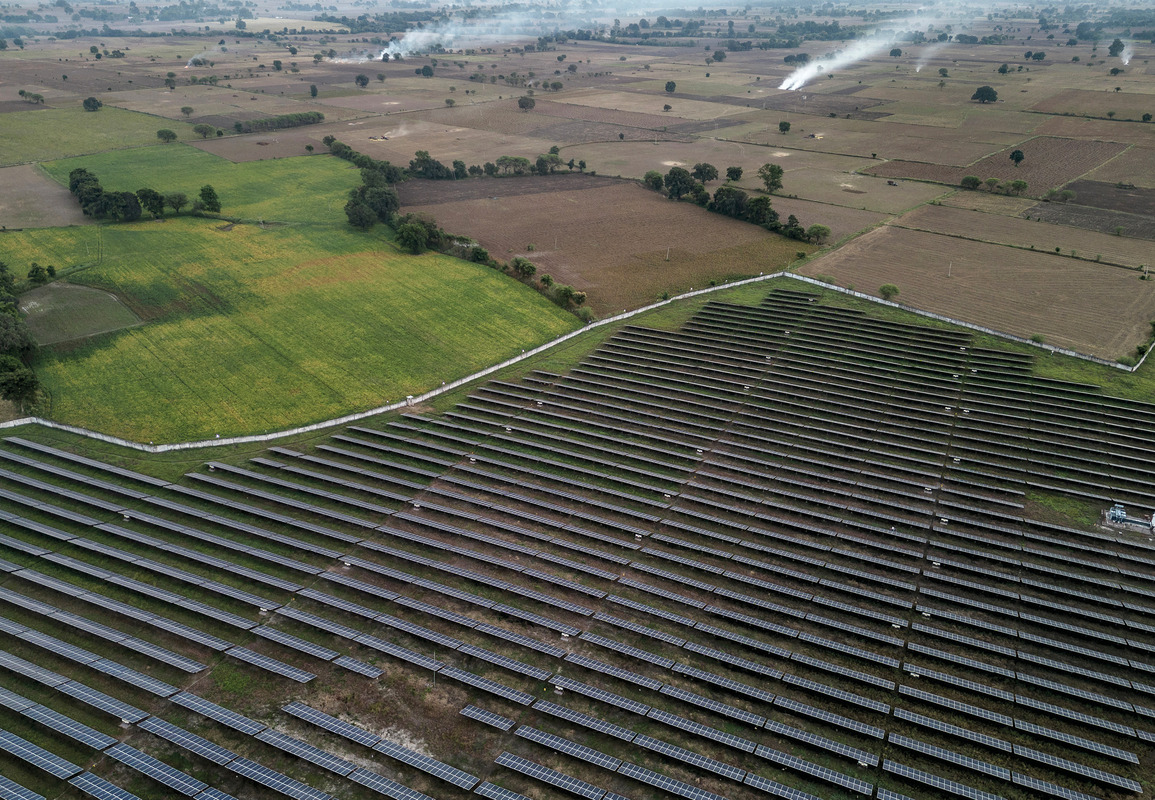
Hungry for land - India wants to generate 500 gigawatts of renewable energy by 2030, which will require vast areas of land, such as here in Lalitpur
Together we can do more
Kali Charan, Badanpur’s village council member, is sitting outside his house under a tree on a mud street, his arms crossed. Unlike the Sain couple, who live in the street parallel to Kali Charan’s house in this sleepy village with children playing lazily in the sun, he is unhappy with the deal he got – 560 Euros an acre - when he sold his land for the solar park about a decade ago. Since then, he is on a mission. Charan is an imposing figure, not so much because of his size, but because of his powerful voice, dark moustache and confident manner.
When solar developers approached villagers of Badanpur, many were almost eager to give away their land they had long considered worthless for its dwindling yields to the first-ever industry that set foot in this region. Now, the wisdom of hindsight and learnings from those like Swain who cracked good deals, has spawned a movement of sorts as the region draws more industries as part of a larger government push for Bundelkhand’s development, the first in many decades.
The demand for land has nurtured a newfound respect for patches of infertile, barren land that many deemed as useless for decades. And Kali Charan is playing a key role in this movement: has brought together village council heads of 33 villages, opened a negotiation door with government authorities, about the minimum price of land, about housing and jobs for landowners. „My land would be worth 7000 Euros per acre now as irrigation facilities in the region have improved,“ Kali Charan says explaining more water canals now feed farms, that should be factored in the land deals.
Local authorities set a minimum rate for land for each village. Companies that buy land must offer deals upwards of the minimum amount. They gauge land’s worth based on its location – plots closer to the road or those that sit right at the centre of a vast field fetch better rates as against far-flung fields that are not easily accessible.
Authorities said in Bundelkhand, land for state-run solar parks was being taken on an annual lease of 20,000 rupees for an acre, but private companies setting up plants are allowed to negotiate their own deals. The final deal eventually hinges on the negotiation ability of the landowner.
This uneven experience has brought together the group representing nearly 40,000 villagers in the region, who are now fighting for good deals. They first came together about a year ago after news stories appeared in the local press about an industrial development project in their region that would require land. A local teacher approached the village councils, explaining to them what this industrial growth would mean and how they can benefit from it. „We have been holding camps and awareness sessions across villages. Our first fight is for a good land rate,“ said Kali Charan.
The collective is a first such initiative in this belt according to officials and local villagers. The collective’s members prepare their talking points on a WhatsApp group, hold meetings and then approach district officials to increase the minimum selling price of their land, to ensure better negotiations with project developers. The WhatsApp group has members share newspaper clips, meeting plans and draft forward looking questions on employment for children.
The collective is being noticed, with growing resistance also setting the tone for how officials are planning these projects. Anupam Shukla, director, Uttar Pradesh New and Renewable Energy Development Agency that is overseeing renewable projects in Bundelkhand, claims that efforts are being made to accommodate the villagers. However, apart from verbal assurance, the villagers of Badanpur said no written assurance has come their way yet.
Junaid Ahmad, a chief development officer in charge of Badanpur, says: „Earlier, farmers practiced agriculture on their small farms and ate what they grew on it. They had no other interactions. Now they are getting consolidated for the first time as land deals are going on. The collective has empowered them. They are approaching the district head’s office, negotiating better rates. They are no longer alone.“
But a good deal also includes financial education, adds Kali Charan of the village council in Badanpur. His groups is planning to educate villagers on how to invest the money they make, and not squander it on „clothes and food“ like many did the last time. After all, land is an asset for the poor, even if infertile. Those who give it up need to plan for what comes next.

Far-sighted investment - farmer Rekha Sain used the proceeds from the sale of her old field to buy a better one
Longing for clouds
Aasa Ram, 40, in Pawa village, about 30 kilometers from Badanpur, was among those who was relieved to let his farm go for a solar project. His land was „rocky and dry“ and he didn’t question the annual lease amount of 223 Euros he was offered for the next 30 years. This means, he will make 6700 Euros in 30 years – as much as the Sains made at one go. Not a particularly good deal.
„I have to put no effort to make this money. Farming on this land was difficult and then stray animals would come on it and I had to drive them away. I know the money is not big, but it helps in meeting my daily expenses,“ said Ram, father of five, sitting in his thatched roof hut on this prickly afternoon. He migrates to nearby towns to work on daily wage at building construction sites.
He is no weather expert but is certain the village’s climate damage is now irreversible. „The last time I saw a rain cloud was 20 years ago. As a child, I even knew the direction they would come from,“ he said, pointing at the sky showing the spot the clouds would first appear, carrying moisture and hope for rain. „But I don’t know where those clouds have gone,“ said Ram wistfully as if he had lost a childhood friend.
Sanjay Singh, founder of nonprofit Parmarth Samaj Sewi Sansthan that works on water crisis mitigation in Bundelkhand, says: „In the last ten years, 30 per cent of the farmers quit farming. There is a lot of wasteland.“
In addition, the power supply is unreliable. Even when local people make their land available for solar installations, the electricity generated does not go to them, but is fed into the country's main grid, which mainly serves large cities and industrial areas. It is often dark for hours in the huts next to the solar farms. Current supply is patchy and powercuts routine.


Rare rise - Kanta Prasad Sain was a hairdresser, now he owns a fertile field, two buffaloes and earns significantly more (above)
New income - the Sains' buffaloes produce milk, which the son takes to the local dairy (below)
Life next to the future
It is climate change caused by people far away that has led to the droughts that are now forcing the farmers of Bundelkhand to sell their land so that solar farms can be built to stop global warming.
The ‘loss and damage’ funds pledged by nations on the first day of COP 28 in Dubai in 2023 to help poor nations cope with climate disasters are much needed in such regions. According to experts, investment in climate-resilient agriculture is essential.. Until those steps are taken, the degradation of land will continue, with the soil on vast fallow fields in the region losing its water-holding capacity, turning it uncultivable.
A just transition – a fair and inclusive shift from fossil fuel to clean energy – would otherwise remain an elusive goal if new energy projects overlook local communities needs and aspirations. It is therefore important that local people know what their land is worth, what they can do with the profits and what new job opportunities are available.
The 33 villages in Bundelkhand that have now joined forces are far removed from global climate dialogues, concerns about emissions and countries' net-zero targets. For them, the rapidly growing renewable sector is an industry that sits in their backyard, on what was once their farmland, and must bring with it jobs, skill training, better roads and hospitals. Yet that seems not to be the case often times.
„We understand solar is a good project. But we are not gaining anything,“ said Mahender Singh Yadav from the village council of Pawa, where a state-run solar project is coming up on 1400 acres of land. A local youth at Pawa who did not wish to be identified said he had completed his graduation and thought he would get work at the solar park. But there were no jobs. An entire section of the village has rows of houses that are shut, a padlock on their doors as people continue to migrate to seek work in cities and towns. „They could have at least given us computer training. The government ran a sewing training centre but shut it in three months,“ the youth said.
Anupam Shukla of the state renewable energy body said they were carrying out skill development programmes of about 30,000 youth in Uttar Pradesh, investing in roads and health facilities with plans afoot to invest in the education of children and also in agricultural land. On the other side of the Bundelkhand fence, there is often neither enough electricity nor jobs.The new industries offer hope for employment, but that dream may not realise until basic facilities are provided. Sample this: the nearest hospital to Badanpur is 20kms away, the nearest college 30 kms away and the nearest secondary school (offering classes up to the tenth grade) an hour-and-a-half long commute away. This means only a handful of boys and even fewer girls pursue an education, limiting their chance to bag jobs in the solar or the other upcoming industries in this region. Less than three quarters of Bundelkhand’s population has basic literacy, few make it to secondary school and even fewer to college.
As the sun sets in Badanpur, the women of the village gather in their best saris, their heads chastely covered. Near a large tree, they offer small dishes to Mahalaxmi and say prayers. The Hindu goddess is said to ensure both financial prosperity and spiritual well-being. Rekha is also there. The land deal has given the family rare recognition in her caste-conscious village that would consider a barber’s family amongst the lowest in social hierarchy. „People respect me now,“ says Kanta Prasad Sain in his raspy voice, sounding tired at the end of a long day's work. That's not enough for his wife Rekha. She hopes that her two sons and daughter will find jobs so that they can break free from farming. ---

Joint resistance - the solar boom has brought the region's residents together and they are now negotiating better land prices together


Offerings - Rekha Sain prepares small dishes for the goddess Mahalaxmi in her hut (l.)
Looking ahead - today Aasa Ram can sometimes laugh about the fact that he was ripped off when he sold his land (r.)
India, the world's most populous country with a growing demand for energy, is the third largest emitter of greenhouse gases and the second largest coal producer after China. The country aims to increase its renewable energy capacity to 500 gigawatts by 2030. At the start of 2023, it stood at 188 gigawatts - enough to meet half of India's energy needs. According to the International Energy Agency, India's ambitious expansion targets will require an investment of nearly $300 billion.
But the biggest challenge is land scarcity. According to a 2021 study by the think tank Institute for Energy Economics and Financial Analysis, India will need an area of 75,000 square kilometres (more than the size of Ireland) for new solar farms and 20,000 square kilometres for new wind farms to meet the government's target of zero emissions by 2050. Experts expect delays in the face of growing opposition from local residents.
The country's largest energy companies - Reliance Industries, led by Mukhesh Ambani, and Adani Green Energy, led by Gautam Adani - have boldly announced that they will install 100 gigawatts and 45 gigawatts of additional renewable capacity respectively within six years. But this will only create a few jobs. According to a 2022 study by the International Labour Organisation, only 13.7 million people are employed in the sector worldwide, seven per cent of them in India.
Despite the solar boom, India is not abandoning coal. On the contrary, production is set to rise from 540 million tonnes in 2012 to more than 700 million tonnes in 2022. According to the country's coal ministry, there are still huge untapped reserves, especially in the east of the country. The cheap fuel currently meets a good half of India's energy needs. Instead of a phase-out, there is talk of a "gradual reduction" in coal use. In February, the government said this approach demonstrated India's unwavering commitment to meeting the country's energy needs while promoting economic growth.
––––––––

This series is funded by the European Journalism Center, as part of the Solutions Journalism Accelerator. This fund is supported by the Bill & Melinda Gates Foundation.
None of these organizations have any influence on the content.